

Event Report: NIC-Japan seminar on Myanmar's Education System and Higher Education Qualifications
Activities
The National Information Center for Academic Recognition Japan (NIC-Japan) held an online seminar entitled "Myanmar's Education System and Higher Education Qualifications" on Friday, June 19, 2026.
As part of its efforts to provide information that contributes to the smooth recognition of higher education qualifications for the purpose of improving the international mobility of students and academics, NIC-Japan has been holding the "NIC-Japan Seminar Series" since 2021. Each seminar features presentations by domestic and international experts on various topics related to recognition of foreign qualifications, including examples of overseas education systems and procedures for qualification evaluation.
The first seminar of FY2026 focused on Myanmar's education system and higher education qualifications. The seminar featured a lecture by Professor Emeritus Hiromitsu Muta of the Tokyo Institute of Technology.
At the opening of the seminar, Professor MORI Rie, the Executive Director of NIC-Japan, expressed her appreciation to the speaker and outlined the objectives and expectations for the seminar.
In the lecture, an overview of Myanmar's education system and higher education qualifications was presented, covering the overall structure from basic education to higher education as well as recent reform trends. Detailed explanations were provided using extensive data and materials on various topics including the transition to the KG+5-4-3 system (one year of kindergarten, five years of primary education, four years of lower secondary education, and three years of upper secondary education), the role of the Matriculation Examination*, the disruption to education caused by the coup d'état and the COVID-19 pandemic, and analyses of changes in student numbers and academic achievement.
In the field of higher education, the lecture highlighted challenges related to the university admission system and quality assurance, as well as issues arising from the fragmented governance of universities across multiple ministries. Professor MUTA presented his perspectives on the expansion of student mobility and future developments.
During the Q&A session, many questions were raised regarding the completion requirements for upper secondary education (the "Atettan Asin Pinnyaie" program), university admission eligibility based on Matriculation Examination results, and the Grade 12 (G12) system. Participants also showed interest in the education systems in regions outside government control, the reliability of academic certificates, and articulation with international curricula, indicating a strong interest for the international comparability and compatibility of the system.
The seminar was attended by approximately 250 participants, mainly faculty and staff members from Japan and overseas who are engaged in admissions and international affairs at universities and other institutions.
*Matriculation Examination: Until 2019, the Matriculation Examination was administered as a nationwide standardized examination that served both as the certification of completion of upper secondary education and as the qualification examination for university admission. Since 2020, however, the certification of completion of upper secondary education has been delegated to individual schools. As a result, the Matriculation Examination has been conducted primarily for the purpose of determining eligibility for university admission.
The presentation material from this seminar is available here.
*The presentation material reflects the 2026 results on Slide 23 (Matriculation Examination Applicants, Passers, and Pass Rate) and is posted as the final version.
The recording of this seminar is available on YouTube until the end of January 2027.
The event announcement page of this seminar can be viewed here.
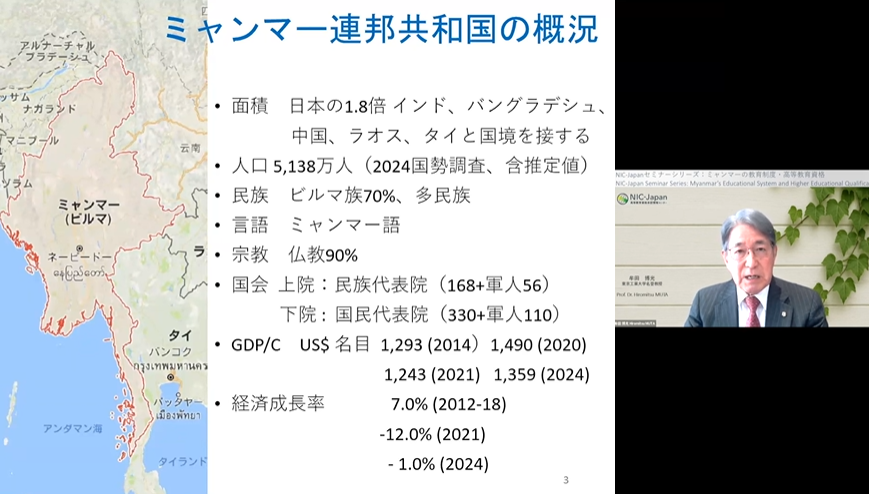 |
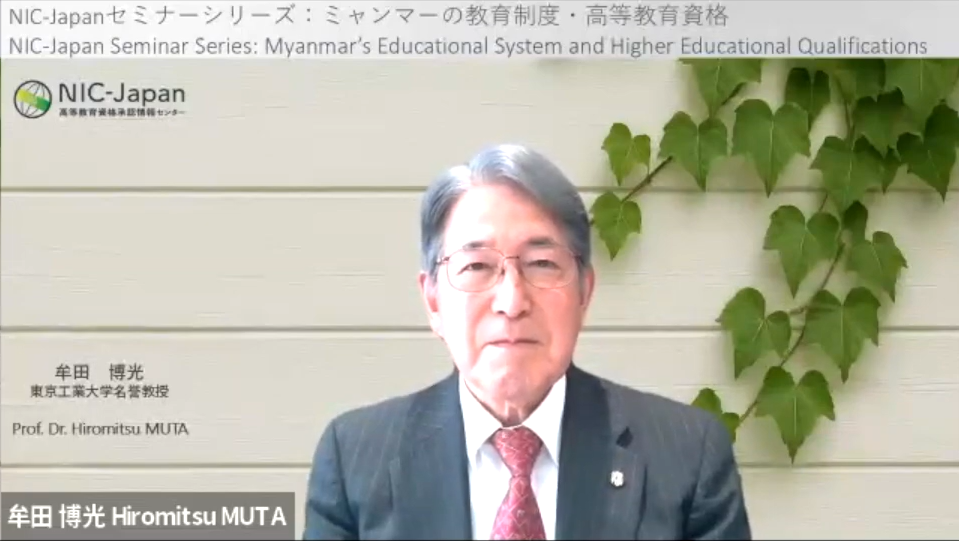 |
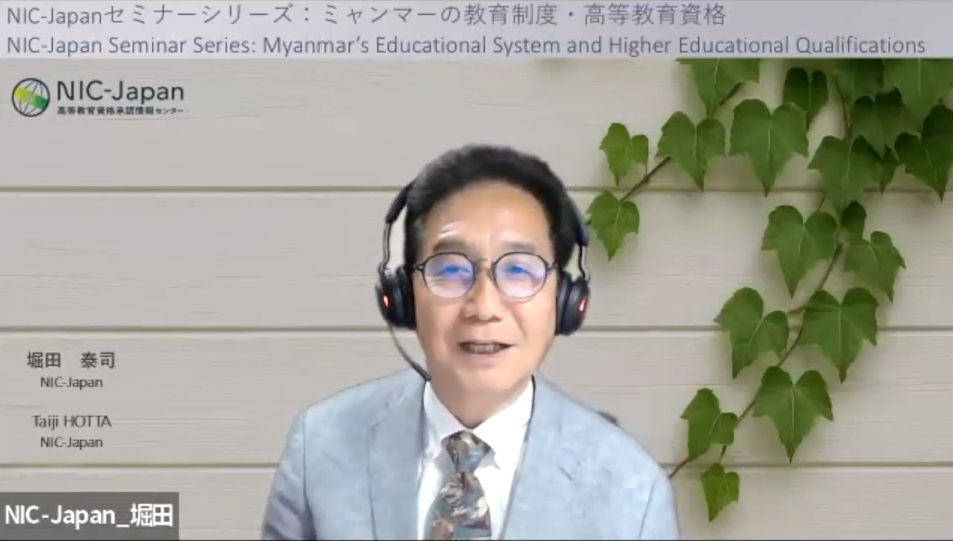 |
| Prof. Dr. Hiromitsu MUTA | Q&A Session with Prof. MUTA, moderated by Dr. HOTTA Taiji, Senior Advisor of NIC-Japan (Right) |