

Report: NIC-Japan Seminar Series: Foreign Credential Evaluation (FCE) Training Program *Presentation Materials and Recording Available
Activities
Presentation materials used in the program can be downloaded from the following link.
Presentation material (In Japanese): session1, session2, session3, session4.
Recording of the program is available on YouTube (in Japanese) until August 20, 2027.
The event announcement page during registration period can be viewed here.
The National Information Center for Academic Recognition Japan (NIC-Japan) held the "NIC-Japan Seminar Series: FCE (Foreign Credential Evaluation) Training Program" online via Zoom Webinar on July 29, 2026. Approximately 200 participants, many of them from higher education institutions, attended the program and furthered their understanding of the fundamentals and recent developments in FCE.
<Purpose of the Program>
This program was conducted for faculty and administrative staff at higher education institutions who are responsible for evaluating foreign academic credentials and the qualifications in the admissions and application screening of applicants with overseas educational backgrounds. It aimed to promote understanding of FCE and enhance professional expertise in this field. Continuing from the previous year's program, participants were provided with opportunities to learn about the principles of the Global Convention and the Tokyo Convention, relevant legislation including the School Education Act, and the fundamental concepts and practices of FCE. The program also aimed to support the development of foreign credential evaluators through sharing information on qualifications from Japan and abroad, as well as expertise related to FCE.
Presentation by Speakers
<Overview>
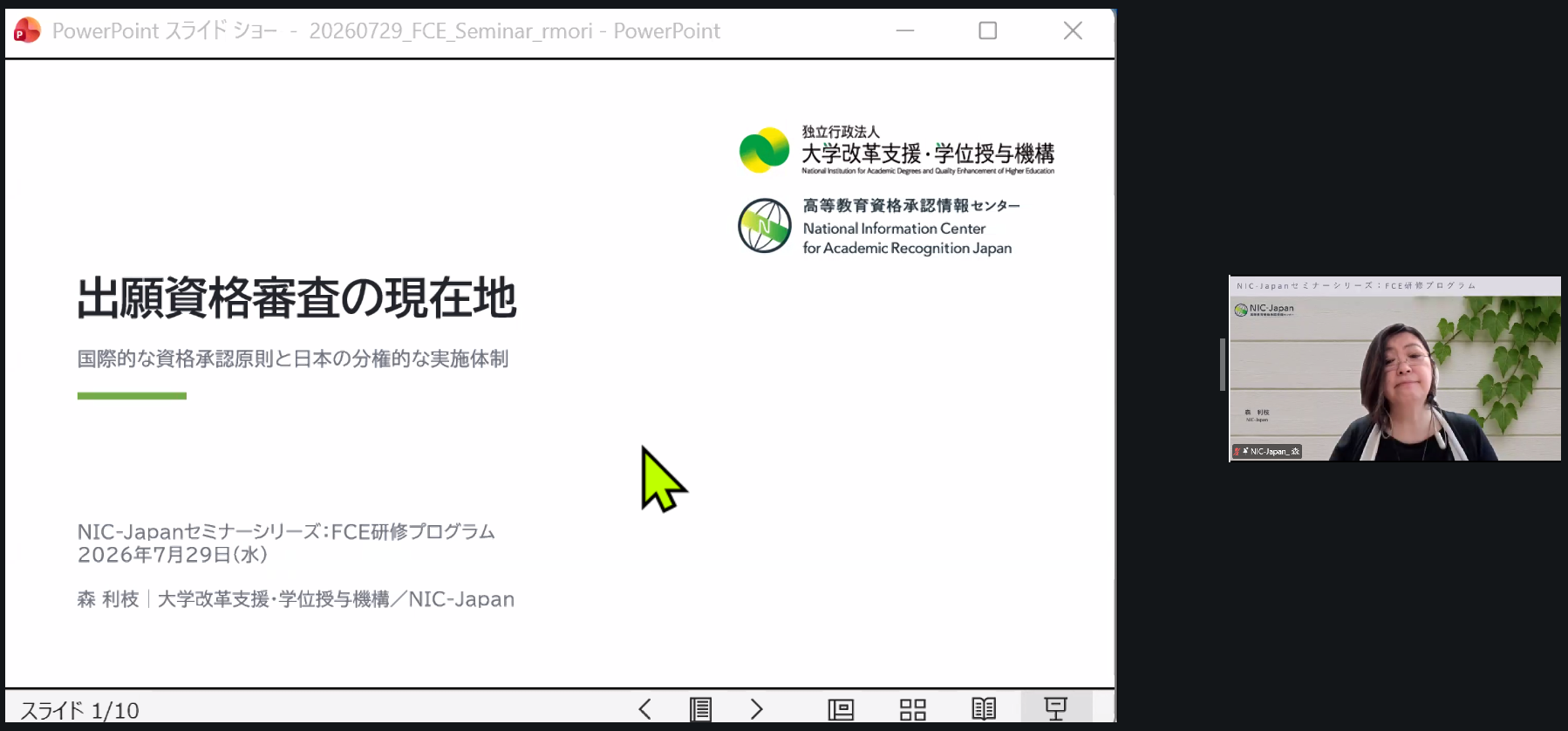
▷Session 1: "The Current State of Foreign Credential Evaluation"
Speaker: MORI Rie, Executive Director, National Information Center for Academic Recognition Japan (NIC-Japan)
Executive Director MORI provided an overview of the current status and challenges of Foreign Credential Evaluation (FCE) for applicants with foreign qualifications, taking into account international developments in the recognition of qualifications. The session introduced the principles of recognition of foreign qualifications based on the UNESCO's Tokyo Convention and the Global Convention, as well as the framework for FCE in Japan. Executive Director MORI also explained the role of higher education institutions as "competent recognition authorities" responsible for the recognition of foreign qualifications. In addition, information was shared on the implementation of FCE in Japan, including institutional arrangements, years of experience of staff members responsible for FCE, and information-gathering practices, all based on the results of a survey of admissions offices at universities across Japan. Furthermore, the importance of promoting "supported decentralization" through information provision, training opportunities, and network building was highlighted in the context of a decentralized system in which individual higher education institutions are responsible for determining applicants' eligibility for admission.
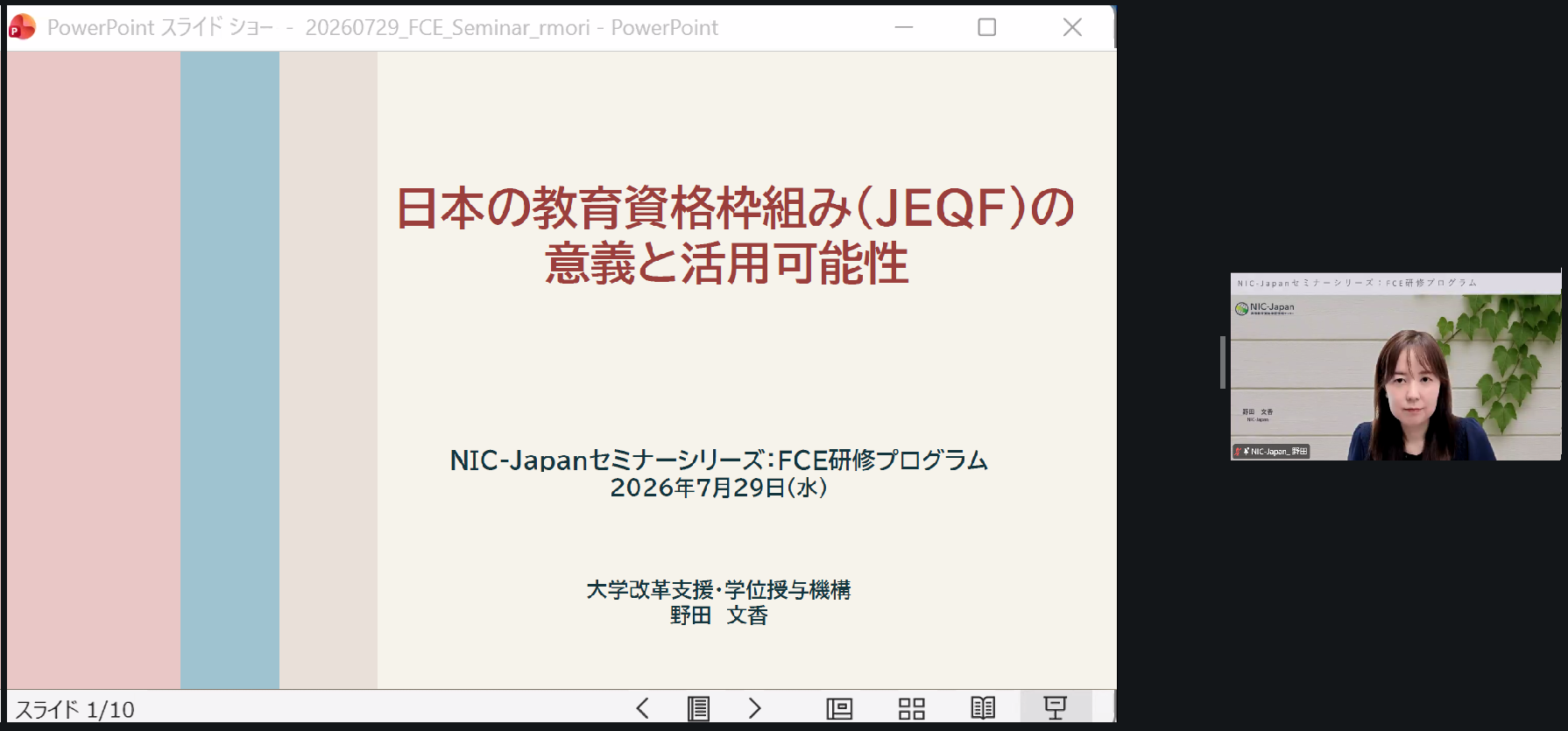
▷Session 2: "The Significance and Potential Applications of the Japanese Education Qualification Framework (JEQF)"
Speaker: NODA Ayaka, Professor, Research Department, National Institution for Academic Degrees and Quality Enhancement of Higher Education (NIAD-QE)
Professor NODA introduced the outline of the Japanese Education Qualification Framework (JEQF) and its potential applications. The session introduced national qualifications frameworks (NQFs) as important mechanisms for comparing and understanding qualifications across countries. She also explained that the International Standard Classification of Education (ISCED), developed by UNESCO, and national qualifications frameworks are used as common reference tools for understanding the level and positioning of qualifications and academic programs. Professor NODA also described the background to the development of the JEQF as a reference guide for appropriately explaining Japanese qualifications internationally and discussed its significance. She also emphasized the importance of diploma supplements, supplementary information, such as learning outcomes, quality assurance, and educational context, in addition to qualification titles when comparing qualifications.
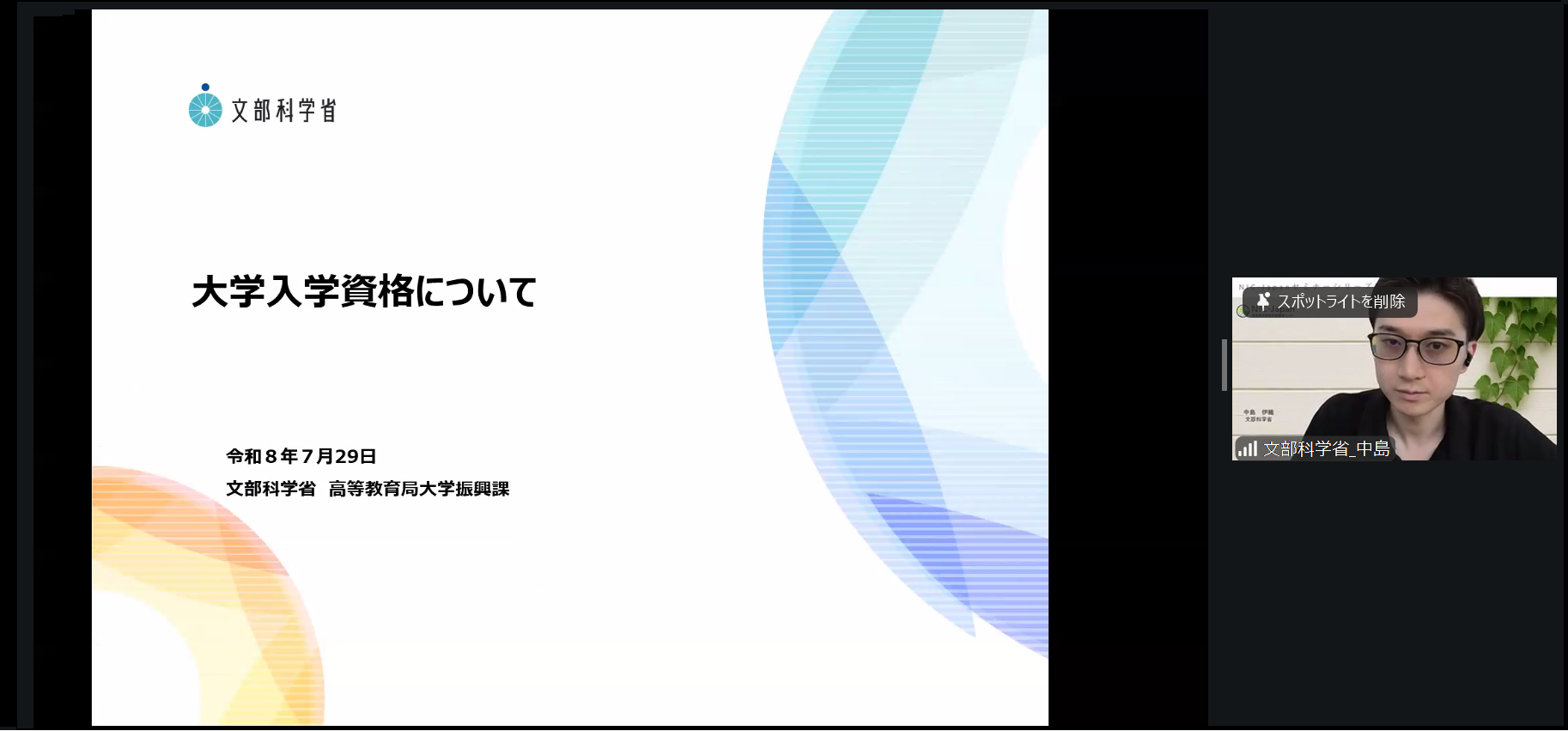
▷Session 3: "Introduction to the University Admission Qualifications Guide"
Speaker: NAKAJIMA Iori, Legal Affairs, University Promotion Division, Higher Education Bureau, Ministry of Education, Culture, Sports, Science and Technology (MEXT)
Mr. NAKAJIMA provided an overview of the University Admission Qualifications Guide and explained the basic principles for determining the eligibility of individuals with educational backgrounds from foreign education systems for admission to Japanese universities. In addition to introducing the purpose of the university entrance qualification system and the structure of the Guide, he emphasized that the evaluation of foreign qualifications should not be based solely on the length of study. Rather, it is important to confirm the position of the educational program within the education system of the country concerned and its connection to higher education. Through examples involving applicants with diverse educational backgrounds, including graduates of foreign school systems and international schools, the importance of making appropriate decisions based on a proper understanding of the intent of the system was highlighted. The session also emphasized the need to refer to the latest information on education systems and official information sources rather than relying solely on past evaluation practices.
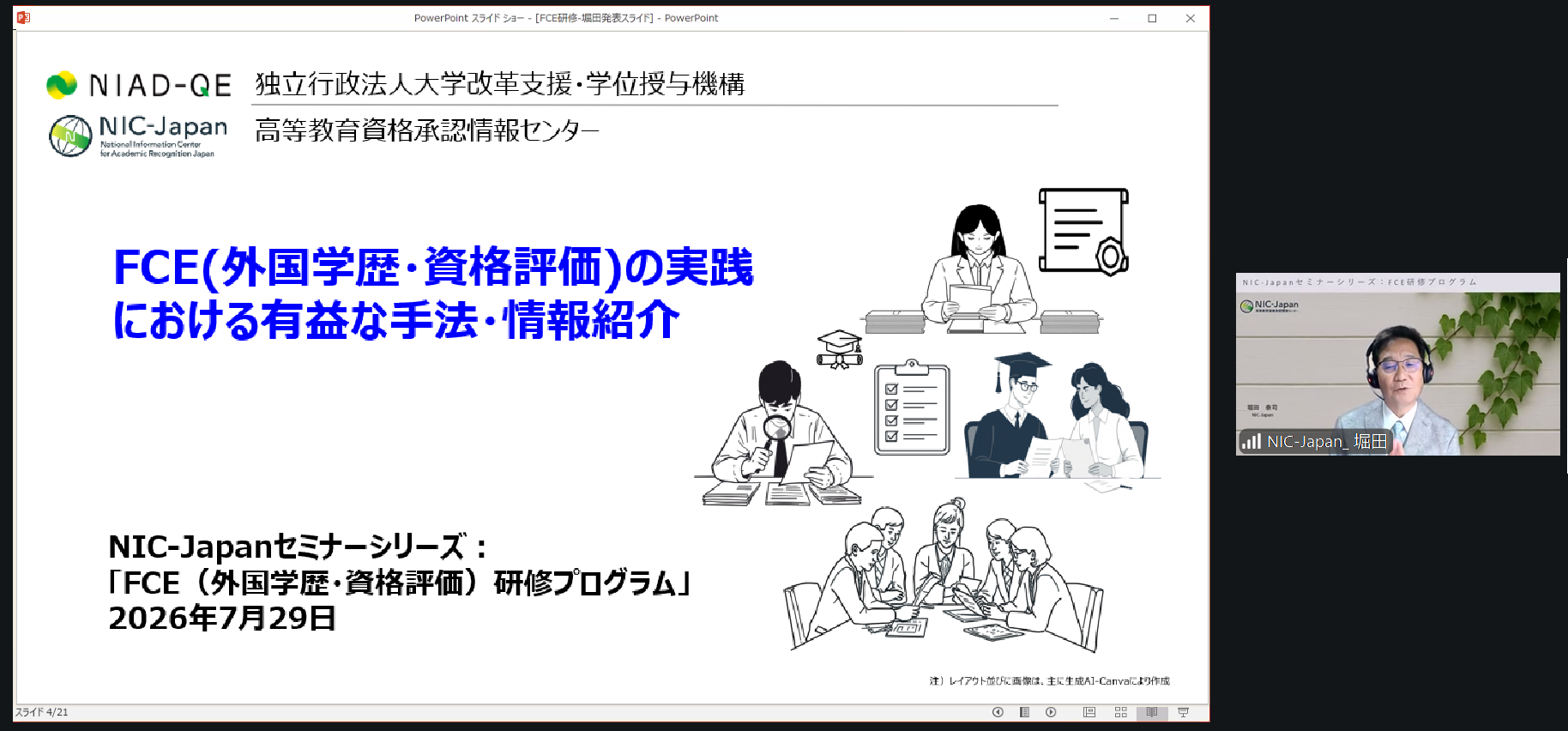
▷Session 4: "Useful Methods and Information Resources for FCE Practice"
Speaker: Dr. HOTTA Taiji, Senior Advisor, National Information Center for Academic Recognition Japan (NIC-Japan)
Dr. HOTTA explained practical approaches to conducting FCE and methods for gathering information. In addition to outlining the basic evaluation procedures used in FCE, he highlighted the importance of verifying the authenticity of application documents and introduced specific points to consider during the verification process. Drawing on examples involving altered documents and fraudulent certificates, he explained methods of authenticity verification, including inquiries into issuing institutions and the use of online verification systems. Furthermore, the session introduced information resources provided by government agencies and educational organizations in various countries, as well as NIC-Japan and overseas recognition bodies, emphasizing the importance of making decisions based on reliable information obtained through consultation of multiple sources.
▷Q&A Session
Speakers: Executive Director MORI, Professor NODA, Mr. NAKAJIMA, and Dr. HOTTA
During the Q&A session following each presentation, participants raised a wide range of practical questions concerning the development of FCE personnel, approaches to the international recognition of qualifications, the administration of Japan's admission eligibility system, and the verification of the authenticity of application documents. Executive Director MORI discussed the importance of institutional arrangements, information provision, and training opportunities tailored to the circumstances of individual higher education institutions. Professor NODA highlighted the importance of providing supplementary information when explaining Japanese qualifications that may be unfamiliar in other countries, including information on qualification levels and quality assurance mechanisms. Mr. NAKAJIMA elaborated on the basic principles used in determining eligibility for admission and discussed considerations in assessing applicants with diverse educational backgrounds. He also provided practical guidance on cases that often pose challenges in decision-making, such as the recognition of qualifications from countries with 13-year education systems. Dr. HOTTA highlighted the importance of authenticity verification and the accumulation and sharing of FCE-related expertise. The discussion provided participants with an opportunity to deepen their understanding of FCE.
▷Summary and Closing Remarks
Speaker: Executive Director MORI
In her closing remarks, Executive Director MORI expressed appreciation to the speakers and summarized the key messages of the training program. She reaffirmed that higher education institutions play an important role as competent recognition authorities responsible for making autonomous and reasonable decisions in Foreign Credential Evaluation. She also noted that FCE practice requires a variety of judgements and emphasized the importance of sharing the knowledge and case examples accumulated by higher education institutions and NIC-Japan, as well as deepening mutual understanding through professional networks. Finally, she stated that NIC-Japan will continue its efforts to provide information and training on FCE and to strengthen collaboration with relevant stakeholders. The program concluded with a renewed appreciation for the importance of sharing expertise, exchanging good practices, and building professional networks in the field of FCE.